









NMC 2026 Draft Rules: FMGE Still Mandatory for MBBS Abroad Students, Not NExT
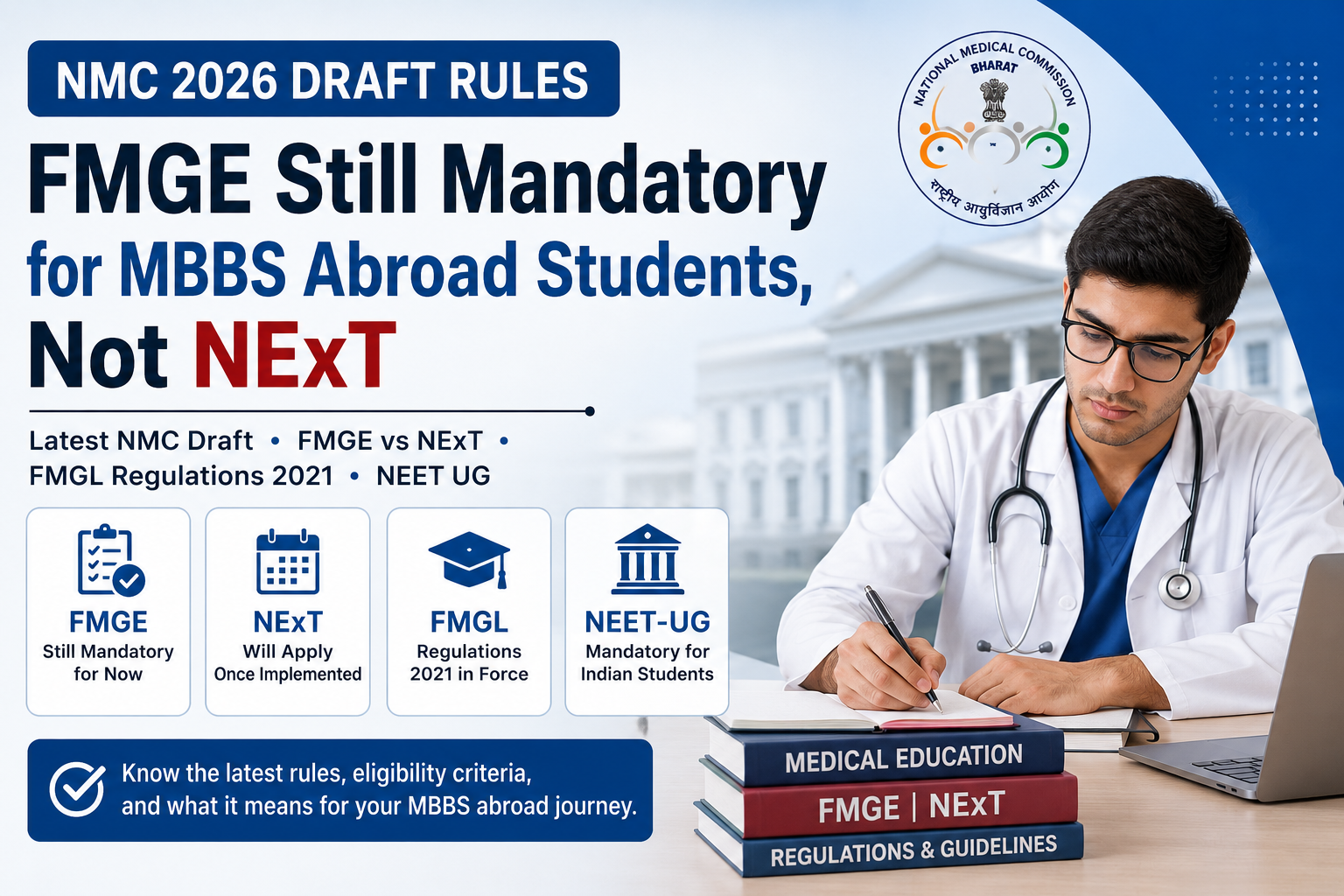
Understand the latest NMC 2026 draft rules for MBBS abroad students. Learn why FMGE remains mandatory, when NExT may replace it, and the key FMGL 2021 eligibility requirements for Indian medical registration.
NMC 2026 Draft Rules: FMGE Still
Mandatory for MBBS Abroad Students,
Not NExT
Category: NMC & Regulatory Updates | All About Doctor Blog
Tags: NMC 2026, FMGE, NExT exam, MBBS abroad, FMGL Regulations, NEET UG
If you've spent any time this month reading up on MBBS abroad, you've probably
run into two completely different claims about the same rule. One site tells you
NExT has already taken over from FMGE. Another insists FMGE is still the exam
you'll need to sit for. They can't both be true, and given that this decision involves
five or six years of your life, a visa, and a fair amount of money, "probably true"
just doesn't cut it.
So here's where things actually stand. On 11 August 2026, the Ethics and Medical
Registration Board of the National Medical Commission notified a fresh draft
amendment to India's medical registration rules. Tucked into the legal wording is
a line that matters enormously if you're planning to study medicine outside India:
FMGE — not NExT — is still the exam foreign medical graduates need to
clear, and that stays true until NExT is actually rolled out.
This piece walks through what the draft says, what's already settled law versus
what's still up for debate, the eligibility conditions under the FMGL Regulations,
2021, and a checklist you can use before trusting anyone's claims about your
specific situation — university brochures included.
What did NMC actually propose in August 2026?
To understand why this matters, you need a bit of backstory. NMC regulatesmedical registration through the Registration of Medical Practitioners and Licence
to Practice Medicine Regulations, 2023. Those original rules assumed NExT — the
still-unlaunched common licensing exam — would already be up and running by
the time foreign medical graduates needed it for registration. That assumption
simply didn't hold up. NExT has been pushed back again and again since it was
first floated, including a mock test that got cancelled in 2023 after MBBS batches
protested that its introduction broke provisions of the NMC Act, 2019.
What the new draft actually changes
The August 2026 draft fixes that mismatch. Where the 2023 wording pointed only
to NExT as the qualifying exam, the new draft now says an FMG becomes eligible
for provisional registration and NMR entry by clearing FMGE, "or the National
Exit Test once NExT comes into force" — whichever is actually operating at the
time. Read between the lines and NMC is essentially admitting what everyone
already knew: FMGE is still the real requirement today, even as the door stays
open for NExT to take over eventually.
The same draft also proposes something separate but related — a centrally
generated Unique Identification Number for every registered doctor, meant to let
practitioners work anywhere in India without re-registering state by state each
time.
Why the draft-versus-final distinction actually matters
Worth repeating: this is still a draft. NMC has opened it up for objections and
suggestions, and the proposed changes won't even be considered until 30 days
after the gazette notification goes public. So the exact wording could shift before it
becomes binding. Treat this as the clearest signal yet of which way NMC is leaning
— not a rule carved in stone — and check for a final version closer to whenever
you're actually making an admission decision.
FMGE vs NExT — untangling the confusion
Two separate questions keep getting mixed together, so let's pull them apart:
First — which exam applies to you right now? FMGE, run by the National Board of
Examinations twice a year. Second — will that ever change to NExT? Almost
certainly, at some point. NMC has said NExT is meant to eventually become the
common exit exam for everyone, Indian and foreign graduates alike. But NMC's
own chairperson has previously suggested it might not be ready for a couple more
years, and this August draft is about as clear a confirmation as you'll get that
FMGE remains the actual requirement in the meantime.
If an agent or a university's marketing material tells you NExT has already
replaced FMGE for foreign graduates, that simply isn't backed up by NMC's
current draft. Worth double-checking before you take it at face value.The rules that are already locked in — FMGL Regulations,
2021
While the FMGE/NExT question is still moving, the eligibility framework that
decides who can even attempt Indian registration after MBBS abroad has been
settled since 2021. It's called the Foreign Medical Graduate Licentiate
Regulations, notified on 18 November that year, and it isn't going anywhere.
NEET-UG isn't optional
Every Indian citizen or OCI who wants their foreign medical degree recognised
back home needs to have qualified NEET-UG — this was also upheld by the
Supreme Court, for what it's worth. Here's the part people miss: a university
abroad admitting you without a NEET scorecard doesn't mean your degree is
somehow invalid to study there. It means it won't be recognised in India later.
Admission and recognition are two separate conversations, and mixing them up is
one of the most common — and most costly — mistakes in this entire space.
Duration, language of instruction, and where you do your internship
A handful of conditions decide whether your foreign MBBS actually counts in
India:
At least 54 months of academic study — no shortcuts here.
The entire course taught in English. Partial or bilingual programmes don't
qualify, however good they look on paper.
A 12-month internship completed at the same institution, in the same country,
where you did your academic years. It can't be split up or shifted elsewhere.
The full course, internship included, has to wrap up within a defined window
from when you first enrolled.One more wrinkle: if you enrolled before 18 November 2021, none of this applies
to you — you're governed by the older Screening Test Regulations, 2002, instead.
Worth knowing if you're evaluating an older admission or helping someone who
took theirs a few years back.
Miss even one of these conditions and the whole degree can become ineligible for
Indian registration. There's no partial credit, and there's no appeal once the
problem surfaces after admission — which is exactly why all this needs checking
before tuition gets paid, not after.
The actual path, step by step
1. Qualify NEET-UG in the year you plan to enrol.
2. Shortlist universities and verify — yourself, not just on a consultant's word —
that the programme meets the 54-month, English-medium, same-institution
conditions.
3. Get your NMC Eligibility Certificate before or during enrolment abroad.
4. Finish your degree and your internship at the same foreign institution.
5. Come back to India and sit for FMGE, still the current screening exam, held
every June and December — until NExT formally takes over.
6. Once you clear it, complete a one-year Compulsory Rotating Medical Internship
in India.
7. Register with your State Medical Council and the National Medical Register,
and you're set to practise.
FMGE vs proposed NExT, side by side
Aspect
FMGE (current)
NExT (proposed)
Status
Operative under the August
2026 draft
Announced but delayed repeatedly since 2023
Conducted
by
National Board of
Examinations
Framework not yet finalisedFrequency
Twice a year — June and
December
Not finalised
Who it
applies to
Foreign medical graduates
seeking Indian registration
Eventually meant to cover Indian MBBS finals,
NEET-PG entrance, and FMG licensing together
What to
verify
Exact 2026 session dates,
directly on NBE's site
Any claim that it's "already in force" — check
NMC's notified (not draft) regulation
Where students and parents usually go wrong
A few patterns show up again and again. Trusting an agent's "approved university
list" instead of checking course length, medium of instruction, and internship
structure directly — NMC doesn't publish or endorse any such list, so the
responsibility genuinely sits with you. Assuming NEET doesn't matter because
admission abroad didn't ask for a score, which, as covered above, is a different
question from recognition entirely. Picking a shorter "fast-track" course because it
sounds efficient, when anything under 54 months simply won't be accepted.
Planning to squeeze the internship year into India to save time or money, which
FMGL 2021 doesn't allow. And treating this August draft as if it were already final
law, when it's genuinely still open for comment.
Picking a university that actually holds up
Start by confirming the university and its programme show up in the World
Directory of Medical Schools. Then check, independently, that the course runs 54-
plus months, is taught entirely in English, and that clinical training and internship
happen on-site or at affiliated teaching hospitals in the same country — not
delivered remotely. Get the NMC Eligibility Certificate process explained to you in
writing, not just verbally, and confirm which regulation year applies to your
specific admission — FMGL 2021, or the older 2002 rules. And whenever someone
tells you where FMGE and NExT currently stand, check it against NMC's own
notified regulation rather than a brochure.
A quick checklist before you apply
NEET-UG qualified for your intended year of admission
University's programme verified in WDOMS
Course duration confirmed at 54+ months
Instruction confirmed to be entirely in English
Internship confirmed at the same institution and country
NMC Eligibility Certificate process understood and started
Current FMGE/NExT status checked against NMC's latest notified regulation
Visa, documentation, and costs planned with a written breakdown — not verbal
promisesWhat to keep an eye on through the rest of 2026
The 30-day comment window on the August draft, and whether NMC issues a final
notified version once it closes. NBE's official FMGE calendar for the rest of the
year and into 2027 — check this directly on their site rather than relying on a
"tentative" date from a third-party blog. And any further NMC notices on eligibility
certificate processing, since procedural requirements here have shifted before,
including a move toward fully online applications.
Regulations change, sometimes quickly. Everything above reflects NMC's August 2026
draft and the FMGL Regulations, 2021, as understood at the time of writing. Please verify
current requirements directly with NMC, NBE, or another official source before making an
admission decision — this article is meant to guide you, not replace official confirmation.
When it's worth talking to someone
Rules like these are exactly why doctor-led counselling tends to beat a purely
transactional agent relationship for MBBS abroad decisions — the gap between a
compliant and a non-compliant course structure isn't always obvious from a glossy
brochure. If you're weighing MBBS abroad options across 12+ countries against a
seat in India, it helps to have someone walk through your NEET score, budget, and
target country against the current FMGL 2021 conditions before you commit to
anything.
Not sure whether your shortlisted university's course structure actually meets NMC's
eligibility conditions? Speak with an experienced counsellor before you pay any
admission fee.
Where this leaves you
The short version: FMGE is still the exam foreign medical graduates need to clear
today, and NExT only takes over once NMC formally implements it — not before.
Everything else that actually decides your eligibility — NEET-UG, the 54-month
rule, English-medium instruction, same-institution internship — was already
settled back in 2021 and doesn't shift based on this draft.
If you're weighing MBBS abroad for the 2026–27 cycle, run every FMGE/NExT
claim you come across through one simple test: does it match what NMC has
actually notified, or is it an outdated assumption carried over from the 2023 rules?
Getting this one distinction right can save you years of headaches later. And if
you're also considering MBBS in India alongside the abroad route, or need help
with NEET UG counselling or NEET PG counselling for this cycle, it's worth
getting guidance built around your actual NEET rank and budget rather than a
generic list of countries.Frequently asked questions
Has NExT replaced FMGE for MBBS abroad students in 2026?
Not yet. NMC's August 2026 draft makes clear that FMGE is still the qualifying
exam for foreign medical graduates. NExT only takes over once it's formally
implemented, and there's no confirmed date for that yet.
Is the August 2026 NMC draft final?
No — it's open for stakeholder objections and suggestions for 30 days from the
gazette notification. It shows where NMC is heading, but the wording could still
change before it's finalised.
Do I need NEET-UG to study MBBS abroad?
Yes. Even if a foreign university admits you without a NEET score, that degree
won't be eligible for FMGE, NExT, or registration in India without one, under
FMGL Regulations, 2021.
What's the minimum course length for a foreign MBBS degree to count in
India?
54 months, taught entirely in English — no exceptions under the current rules.
Can I do my internship in India after finishing my MBBS academics abroad?
No. It has to happen at the same foreign institution where you studied. FMGL
2021 doesn't allow shifting it to India or anywhere else.
What exam do I clear after coming back to India with a foreign MBBS degree?
FMGE, currently — held twice a year in June and December by NBE — followed by
a one-year CRMI internship in India.
Does NMC keep an official list of approved universities abroad?
No, and this trips people up constantly. NMC has been explicit that it doesn't
endorse or maintain such a list. Verifying compliance is on the student.
What about students who enrolled before November 2021?
They fall under the older Screening Test Regulations, 2002, not FMGL 2021.
What's this Unique Identification Number I keep hearing about?
It's a proposal in the same August 2026 draft — a centrally generated ID that
would let a registered doctor practise anywhere in India without fresh state-wise
registration, once finalised.
How do I check whether a rule is still a draft or already final?
Go straight to NMC's official rules and regulations page — it lists notified
regulations as well as anything still open as a draft.Should I just go with MBBS in India instead, given all this uncertainty?
That really comes down to your NEET rank, budget, and preferred country — not
the FMGE/NExT question by itself, since the eligibility conditions apply either way
once you're back and trying to practise. A personalised comparison beats a blanket
rule of thumb here.

Medical Mentor & Founder
As a doctor, I believe medicine is not just a profession — it is a lifelong commitment to serve humanity.Read more
Ready to Take Your Next Steps?
Get in touch with our team to discuss how we can help you achieve your goals
Call Us
+91 9773370141
Available Mon-Sat, 9AM-9PM
Email Us
Info@allaboutdoctor.in
We'll respond within 24 hours
Visit Us
2nd Floor, Santosh vihar, C-62, VIT Rd, Vishwa Vidhyalaya Nagar, Jagatpura, Jaipur, Rajasthan 302017
Send Us a Message
We respect your privacy. Your information will be kept confidential.
Comments (0)
Join the discussion and share your thoughts
Leave a Comment
Comments (0)
No comments yet. Be the first to comment!