









MBBS in India vs MBBS Abroad 2026: Cost, Career and What Students Should Check
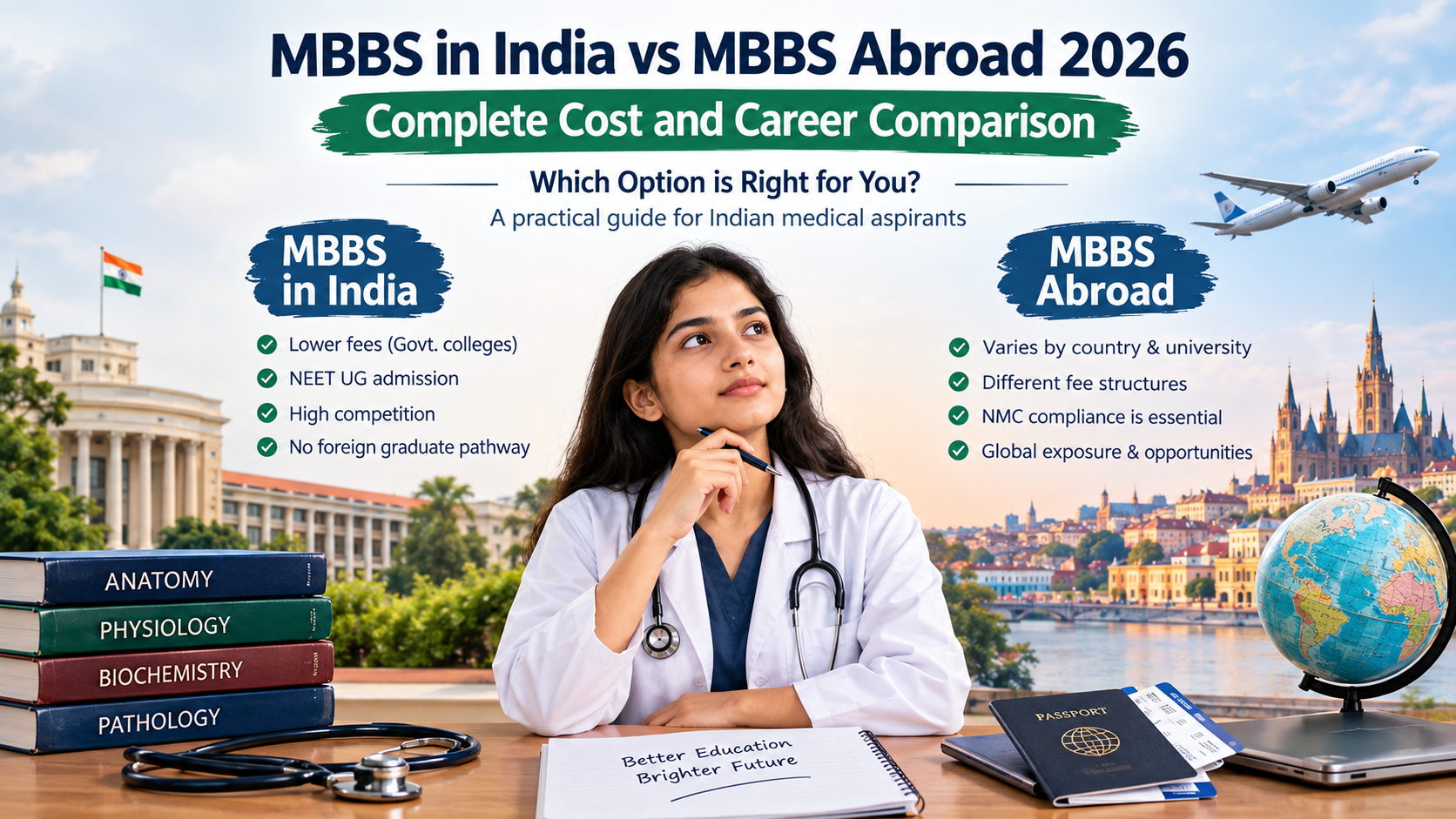
Confused between studying MBBS in India or abroad? Compare tuition costs, admission, NMC requirements, clinical training, licensing and career options to choose the right path for your medical career.
MBBS in India vs MBBS Abroad 2026: Complete Cost and Career Comparison
A practical guide for Indian medical aspirants
MBBS in India vs MBBS Abroad: Which Option Makes More Sense in 2026?
For many Indian students, getting an MBBS seat is only the first part of the decision. The next question is where to study. Government colleges in India can be extremely affordable but highly competitive. Private and deemed colleges offer more seats, but the total cost can be much higher. That is why studying medicine abroad continues to attract attention from students who want another route.
The right choice is not simply the country with the lowest fee. Students also need to look at recognition, course structure, clinical training, internship requirements, future licensing and the total cost of living. This guide compares the two options from those angles so that families can make a more informed decision.
The Competition for MBBS Seats in India
NEET UG remains one of India's biggest entrance examinations. In 2026, the National Testing Agency said that more than 22.79 lakh candidates were registered for the exam. The scale of the competition explains why many students also consider medical education outside India.
Quick Comparison: MBBS in India vs MBBS Abroad
Factor | India – Government | India – Private/Deemed | Abroad |
Cost | Usually lowest | Can be very high | Varies by country and university |
Admission | NEET UG merit | NEET UG + applicable quota/rules | NEET qualification and other eligibility requirements |
Competition | Very high | High, depending on college | Varies by country and university |
Course duration | Usually about 5.5 years including internship | Usually about 5.5 years including internship | Varies; verify the exact programme |
Language | Depends on institution, generally English in medical education | Generally English | Must be checked before admission |
Returning to India | No foreign-graduate licensing route | No foreign-graduate licensing route | Subject to current NMC requirements |
MBBS in India: Cost and Practical Advantages
If a student can secure a government medical college seat, the financial advantage is difficult to ignore. Tuition at government institutions is generally far lower than at private colleges. However, fees vary by state and institution, and students should check the current fee structure of the specific college rather than rely on a general estimate.
Private and deemed medical colleges are a different financial proposition. Tuition, hostel charges and other institutional expenses can make the total cost substantial. The exact amount depends heavily on the college, state, category and applicable fee rules.
Studying in India also means that students are already within the Indian medical education and registration system. There is no separate foreign medical graduate pathway to navigate after graduation.
MBBS Abroad: Why Students Consider It
For students who cannot secure a suitable government seat and who find some private colleges financially difficult, overseas medical education can look attractive. Countries in Eastern Europe, Central Asia and other regions offer medical programmes at different fee levels.
But the phrase 'MBBS abroad' covers very different universities and education systems. A low fee alone is not a good reason to choose a university. Before paying an application or admission fee, students should check whether the programme meets the requirements that apply to foreign medical graduates who want to practise in India.
The Most Important Part: NMC Compliance
This is the section families should read carefully. The National Medical Commission's Foreign Medical Graduate Licentiate Regulations set requirements for foreign medical graduates seeking permanent registration in India. The regulations include a minimum 54-month medical course, a 12-month internship at the same foreign medical institution, English as the medium of instruction and the required subjects. The regulations also provide for supervised internship in India and the required licensing examination or examinations.
NMC has continued to warn students to carry out proper due diligence before joining foreign medical institutions. Its April 2026 advisory specifically highlights course duration, medium of instruction, curriculum, clinical training and internship arrangements as areas students must verify.
NMC also states that it does not endorse a general list of foreign medical universities. That means students should not treat a college advertisement saying 'NMC approved' as enough proof. The university and its programme need to be checked against the applicable rules.
What About Online Classes and Foreign Medical Education?
This area has changed over time and is especially important for students whose education involved online or hybrid teaching. NMC published further guidance in 2026 concerning compensation or supplementation for periods of medical education carried out through online classes. Students affected by such arrangements should read the latest NMC guidance and keep the required university documentation.
Career After MBBS: India vs Abroad
An Indian medical graduate follows the Indian registration and postgraduate pathway after completing the required education and internship. A graduate from a foreign medical institution has additional regulatory steps before practising in India.
The exact licensing pathway is important enough that students should not rely on older articles that automatically describe FMGE or NExT as the same thing. The regulatory position can change, so candidates should check the latest NMC and National Board of Examinations notices applicable to their graduation batch.
For students who want to work in another country, there are also separate licensing routes. The requirements for the United States, United Kingdom, Gulf countries and other destinations are different, so recognition of a degree does not automatically give a graduate the right to practise there.
So, Which One Should You Choose?
There is no single answer that works for every student. Start with your NEET result, your realistic budget and where you ultimately want to practise.
If you have a realistic government-college option
Compare those colleges carefully before looking abroad. The lower cost and straightforward Indian pathway can be major advantages.
If private college fees are outside your budget
An overseas programme may be worth researching, but only after checking the university against current NMC requirements and calculating the complete cost.
If you plan to practise in India
Make NMC compliance the first filter. Do not choose a university only because its fee is attractive.
If you want to work overseas later
Research the licensing requirements of the country where you want to practise before choosing a medical school.
Questions to Ask Before Taking Admission Abroad
· Does the course satisfy the current NMC requirements applicable to foreign medical graduates?
· Is the full course duration clearly documented?
· Where will clinical training take place?
· Where will the internship be completed?
· Is the medium of instruction compliant with the applicable rules?
· What is the complete cost, including tuition, hostel, food, travel and other expenses?
· What happens if the university changes its curriculum or clinical arrangements?
· What documents will the university provide after graduation?
· What licensing route will apply when you return to India?
Common Mistakes Students Make
· Choosing a university only because the advertised fee is low.
· Trusting an admission agent's claim about recognition without checking official sources.
· Ignoring the location and quality of clinical training.
· Assuming every foreign medical degree follows the same rules.
· Comparing tuition fees without calculating the full cost of living.
· Using old information about licensing examinations or NMC regulations.
· Making a decision without thinking about where they want to practise after graduation.
Final Takeaway
MBBS in India and MBBS abroad can both lead to a medical career, but the two routes are not interchangeable. India can offer a simpler path after graduation, while studying abroad may provide another option for students who face intense competition or high private-college costs.
The safest way to compare the two is to look beyond the headline fee. Check the college, course structure, clinical exposure, internship arrangements, regulatory requirements and total expense. Most importantly, use current information from the NMC and other official authorities before making an admission decision.
Frequently Asked Questions
Is MBBS abroad cheaper than MBBS in India?
It can be cheaper than some private Indian medical colleges, but the answer depends on the country, university, tuition, living expenses and exchange rates. A government medical college in India can be much less expensive.
Is NEET required for MBBS abroad for Indian students?
Indian students should check the current NEET and eligibility requirements applicable to the admission year. Do not rely on older admission guides.
Does NMC approve a list of foreign universities?
NMC states that it does not endorse a general list of foreign medical institutions. Students should verify the programme against the applicable regulations.
Can I practise in India immediately after completing MBBS abroad?
Not automatically. Foreign medical graduates must satisfy the applicable NMC requirements and licensing/registration process before practising in India.
What should I check before choosing a foreign medical university?
Check course duration, medium of instruction, curriculum, clinical training, internship arrangements, regulatory compliance and the complete cost of education.
Is the cheapest MBBS abroad option always the best?
No. A low fee is useful only if the programme also meets the requirements that matter for your intended career and registration pathway.
Editorial Note
Medical education regulations and admission requirements can change. This article is intended as general educational information, not a substitute for official admission or regulatory advice. Before applying, students should verify the latest requirements directly with the National Medical Commission, the relevant examination authorities and the university.
Official References
National Medical Commission – Foreign Medical Graduate Licentiate Regulations and student advisories.
National Testing Agency – NEET UG 2026 examination information.
Medical Counselling Committee – UG counselling and participating-institute information.

Medical Mentor & Founder
As a doctor, I believe medicine is not just a profession — it is a lifelong commitment to serve humanity.Read more
Ready to Take Your Next Steps?
Get in touch with our team to discuss how we can help you achieve your goals
Call Us
+91 9773370141
Available Mon-Sat, 9AM-9PM
Email Us
Info@allaboutdoctor.in
We'll respond within 24 hours
Visit Us
2nd Floor, Santosh vihar, C-62, VIT Rd, Vishwa Vidhyalaya Nagar, Jagatpura, Jaipur, Rajasthan 302017
Send Us a Message
We respect your privacy. Your information will be kept confidential.
Comments (0)
Join the discussion and share your thoughts
Leave a Comment
Comments (0)
No comments yet. Be the first to comment!