









Georgia vs Russia for MBBS 2026: Fees, NMC Rules, Clinical Training & Career Prospects
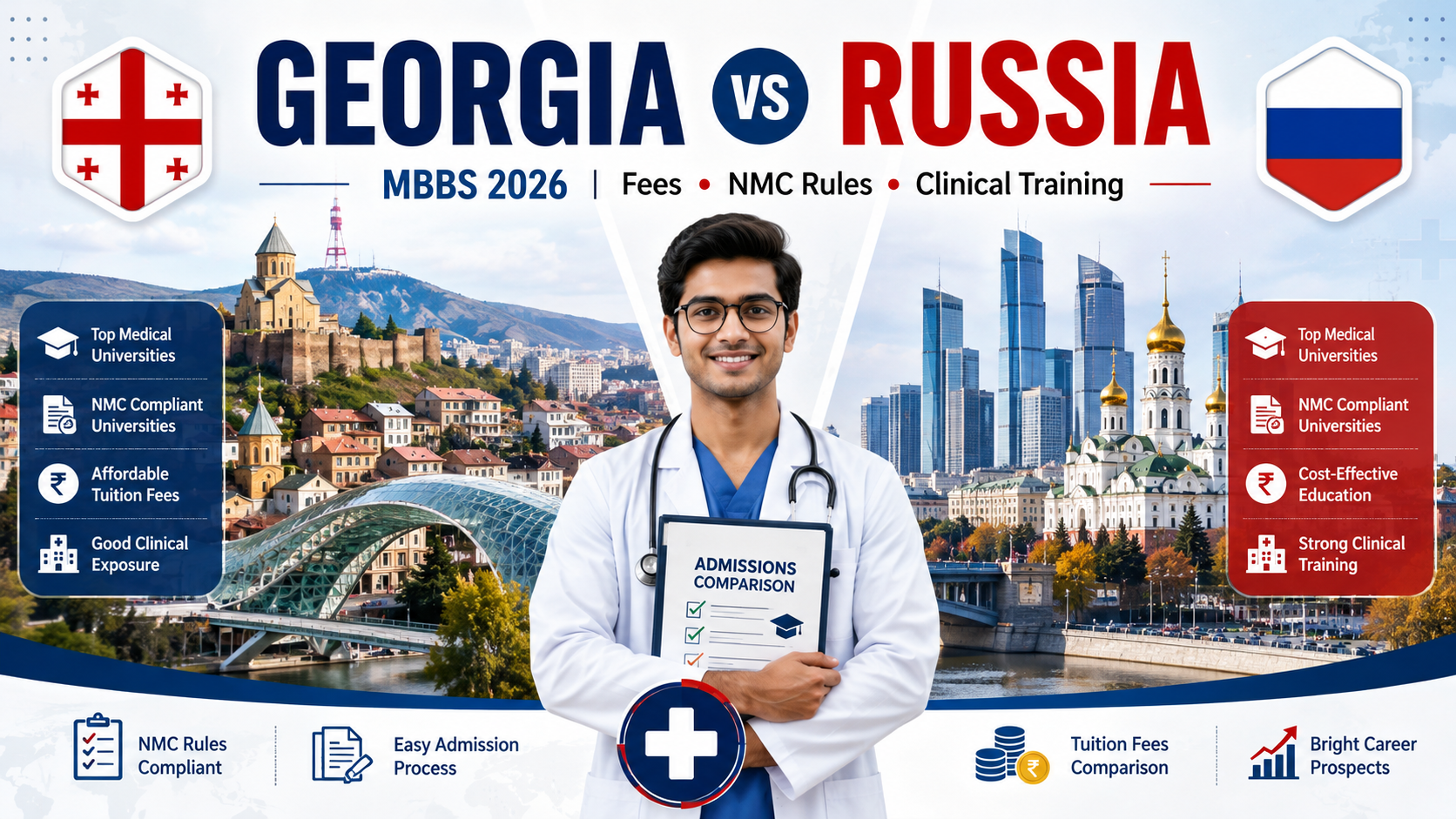
Planning to study MBBS abroad? Compare Georgia and Russia for MBBS in 2026, including fees, NMC requirements, clinical training, licensing pathway, student life and career prospects to make a more informed decision.
ALL ABOUT DOCTOR
Georgia vs Russia for MBBS 2026
Fees • NMC Rules • Clinical Training • Career Prospects
Editorial note: Fees and admission policies can change. Students should confirm the latest requirements directly with the university and relevant Indian authorities before paying fees.
Georgia vs Russia for MBBS: Which Should You Choose in 2026?
You have cleared NEET, a government MBBS seat has not worked out, and now two destinations are on your shortlist: Georgia and Russia. For Indian students, the decision is not simply about which country has the lower tuition fee. The university, course structure, clinical training, total cost and eligibility for medical registration in India all matter.
That is particularly important in 2026. Admission policies in Georgia have changed, while students considering Russia need to think carefully about payment arrangements and current travel conditions. For both countries, the key question remains the same: does the particular medical programme meet the requirements that apply to a foreign medical graduate who wants to practise in India?
Quick Answer
· Russia is generally the lower-cost option on tuition at many universities.
· Georgia can appeal to students looking for a smaller, English-medium study environment, but private-university options need careful checking.
· Neither country makes a medical degree automatically valid for practice in India. University-level compliance with the applicable NMC requirements matters.
· FMGE remains relevant until the NExT system comes into force; students should check current NBEMS/NMC notices rather than rely on old admission articles.
Georgia vs Russia: At a Glance
Factor | Georgia | Russia |
Approx. tuition | US$4,000–8,000/year at many private universities | About ₹3–6 lakh/year at many universities; some cost more |
Course structure | Usually 6 years including internship | Usually 6 years including internship |
Medium | English-medium programmes available | English-medium programmes available |
Admission | NEET + academic eligibility + university application | NEET + academic eligibility + university application |
Climate | Milder winters | Cold winters in most cities |
Clinical exposure | Depends heavily on university and hospital arrangements | Large teaching-hospital ecosystem; varies by university |
Main concern | Private-university quality and current admission policy | Payment, travel/geopolitical conditions and university selection |
Best suited to | Students preferring a smaller setting and moderate budget | Students prioritising lower tuition and wider choice |
NMC Requirements: The Part You Should Not Skip
The Foreign Medical Graduate Licentiate Regulations, 2021 set important conditions for students who plan to return to India and seek medical registration. Among the points students should verify are NEET qualification, the required course duration, English-medium instruction, recognition of the degree in the country of study, and the required internship arrangement.
1. At least 54 months of medical education, covering the required areas of study.
2. 12 months of internship at the same foreign institution, as applicable under the regulations.
3. English as the medium of instruction.
4. The degree must be recognised in the country where it is awarded and provide the required professional rights there.
5. Foreign graduates must meet the applicable Indian licensing and registration requirements, including the relevant examination and supervised internship requirements.
Do not choose a university because an agent calls it 'NMC approved'. Ask for the programme structure, internship details and other relevant documents in writing, then cross-check them with current NMC guidance.
MBBS in Georgia in 2026
What has changed?
Reports indicate that Georgian state universities have changed their approach to new international admissions for the 2026–27 intake, with private institutions continuing to be relevant to Indian applicants. Because admission policies can change quickly, students should confirm availability directly with the university before applying.
Published estimates commonly place private-university tuition around US$4,000–8,000 per year. Hostel and living expenses vary by university and lifestyle. English-medium teaching and a sizeable Indian student community can be advantages, but the quality and clinical arrangements of individual institutions should be checked rather than judged by the country alone.
MBBS in Russia in 2026
Russia remains a popular destination for Indian medical students and can be comparatively affordable. Published estimates often place tuition at around ₹3–5 lakh per year at a number of universities, although costs differ considerably by institution and city.
Students also need to plan for living costs, insurance and payment logistics. International card usage and cross-border payment arrangements can be more complicated than in many other destinations. Cold weather and the need to communicate with patients in Russian are practical considerations as well.
Total Cost: A More Useful Comparison
Cost area | Georgia | Russia |
Tuition | US$4,000–8,000/year at many private universities | ₹3–6 lakh/year at many universities |
Accommodation | Around US$1,000–2,000/year at some institutions; private housing varies | Varies by city and university |
Living costs | Highly dependent on lifestyle and city | Published estimates often around ₹12,000–25,000/month |
Insurance | Usually required; confirm university terms | Usually required; confirm current cost |
Travel / documents | Varies | Varies |
Other costs | Exam preparation, documentation and university charges | Exam preparation, documentation and university charges |
Broad planning range | About ₹25–55 lakh over the full course | About ₹20–50 lakh over the full course |
These are planning ranges, not quotations. Always ask the university for a written fee schedule covering tuition, accommodation, insurance, internship and other compulsory charges.
Clinical Training: Country Matters Less Than the University
A low tuition fee does not automatically mean good clinical exposure. Before paying an admission deposit, ask where clinical postings take place, when they begin, which hospitals are involved, how the internship is organised and whether the arrangement satisfies the rules applicable to foreign medical graduates.
· Is there a university-affiliated or formally associated teaching hospital?
· When do students start clinical postings?
· Where is the final internship completed?
· How many students share clinical teaching and patient exposure?
· Will students need the local language for patient interaction?
Career Options After MBBS
Goal | What you should plan for |
Practise in India | Meet the applicable NMC requirements, clear the required licensing examination, complete the required internship/registration steps |
Postgraduate study in India | Complete the relevant registration pathway and meet current entrance requirements |
Practise abroad | Meet the licensing, examination and registration rules of the destination country |
Non-clinical careers | Explore research, public health, healthcare management and industry roles |
Pros and Cons
Destination | Advantages | Points to consider |
Georgia | English-medium options; milder winters; smaller study environment | Private-university selection requires careful checking; fees may be higher |
Russia | Many universities; comparatively lower tuition at some institutions; large Indian student community | Payment arrangements, cold weather, language and current geopolitical/travel considerations |
Who Should Choose What?
· Choose Russia if lower tuition is a major priority and you are comfortable doing extra due diligence on payments, university arrangements and travel conditions.
· Consider Georgia if you prefer a smaller environment, milder weather and English-medium private-university options, provided the specific programme meets the requirements you need.
· For clinical training, choose the university with the stronger documented hospital arrangement—not simply the country with the better reputation.
· If you are worried about licensing after graduation, focus early on the applicable Indian requirements and build your exam preparation into your six-year plan.
Admission Process: Step by Step
6. Confirm your NEET qualification and academic eligibility.
7. Shortlist three to five universities rather than applying to the first option suggested by an agent.
8. Check the programme duration, medium of instruction, internship and recognition details.
9. Compare the full cost in writing, not only the tuition fee.
10. Review the university's admission letter and refund terms.
11. Complete document attestation and visa requirements.
12. Confirm accommodation, insurance, payment arrangements and student support before travelling.
Common Mistakes Indian Students Make
13. Using an old article that does not reflect the latest admission policy.
14. Comparing countries only on tuition fees.
15. Trusting the phrase 'NMC approved' without checking the actual programme.
16. Accepting a course structure that may not satisfy the required duration or internship conditions.
17. Paying a large amount before receiving a written fee schedule and refund policy.
18. Waiting until the final year to think about the licensing examination.
19. Failing to plan payment and money-transfer arrangements for Russia.
20. Assuming that an overseas MBBS degree automatically guarantees a licence or job in India.
Final Verdict
There is no universal winner between Georgia and Russia. Russia can be more attractive on tuition, while Georgia may suit students who prefer a smaller environment and milder climate. The more important comparison, however, is between the individual universities.
Before you pay an admission fee, compare the complete cost, course duration, clinical training, internship arrangement, recognition and the current requirements for returning to India. Shortlist three universities, collect their information in writing and compare them side by side. That approach is far safer than choosing a country because an agent or a ranking website says it is 'best'.
Internal Links for All About Doctor
· MBBS Abroad: https://allaboutdoctor.in/mbbs-abroad
· MBBS in Georgia: https://allaboutdoctor.in/mbbs-abroad/georgia
· MBBS in Russia: https://allaboutdoctor.in/mbbs-abroad/russia
· NEET UG Counselling: https://allaboutdoctor.in/neet-ug-counselling
· MBBS in India: https://allaboutdoctor.in/india
· NMC Updates: https://allaboutdoctor.in/nmc-updates
· MBBS in Kazakhstan: https://allaboutdoctor.in/mbbs-abroad/kazakhstan
· MBBS in Uzbekistan: https://allaboutdoctor.in/mbbs-abroad/uzbekistan
Authoritative Sources to Cite
· NMC – Foreign Medical Graduate Licentiate Regulations, 2021
· NBEMS – FMGE notices and examination updates
· NTA – NEET UG information
· MCC – counselling information
· WDOMS – World Directory of Medical Schools
FAQs
Is MBBS in Georgia valid in India?
It can be, provided the individual programme satisfies the applicable requirements for foreign medical graduates and the graduate completes the required Indian licensing and registration pathway.
Is MBBS in Russia valid in India?
The same principle applies. The country alone does not make a degree eligible; the specific programme and the graduate's compliance with Indian requirements matter.
Which is cheaper, Georgia or Russia?
Russia is often cheaper on tuition, but the total cost can change significantly by university, city, accommodation and other expenses.
Is NEET required for Indian students?
Indian students who intend to pursue the applicable foreign medical graduate pathway in India should meet the current NEET requirements. Verify the latest rule before applying.
How long does MBBS take in Georgia or Russia?
Programmes commonly span about six years including internship, but students should verify the exact structure and ensure it meets the applicable requirements.
Which country has better clinical training?
There is no reliable country-wide answer. Compare the hospital access, clinical schedule, internship arrangement and patient exposure of the individual university.
What should I check before paying fees?
Check the written fee schedule, programme duration, medium of instruction, clinical training, internship, recognition and refund terms.
Should I choose based only on low fees?
No. A lower tuition fee is useful only if the university and programme also meet the academic and regulatory requirements you need.

Medical Mentor & Founder
As a doctor, I believe medicine is not just a profession — it is a lifelong commitment to serve humanity.Read more
Ready to Take Your Next Steps?
Get in touch with our team to discuss how we can help you achieve your goals
Call Us
+91 9773370141
Available Mon-Sat, 9AM-9PM
Email Us
Info@allaboutdoctor.in
We'll respond within 24 hours
Visit Us
2nd Floor, Santosh vihar, C-62, VIT Rd, Vishwa Vidhyalaya Nagar, Jagatpura, Jaipur, Rajasthan 302017
Send Us a Message
We respect your privacy. Your information will be kept confidential.
Comments (0)
Join the discussion and share your thoughts
Leave a Comment
Comments (0)
No comments yet. Be the first to comment!