









NRI Quota MBBS Seats in India: Fees, Eligibility, and Who Actually Qualifies (2026)
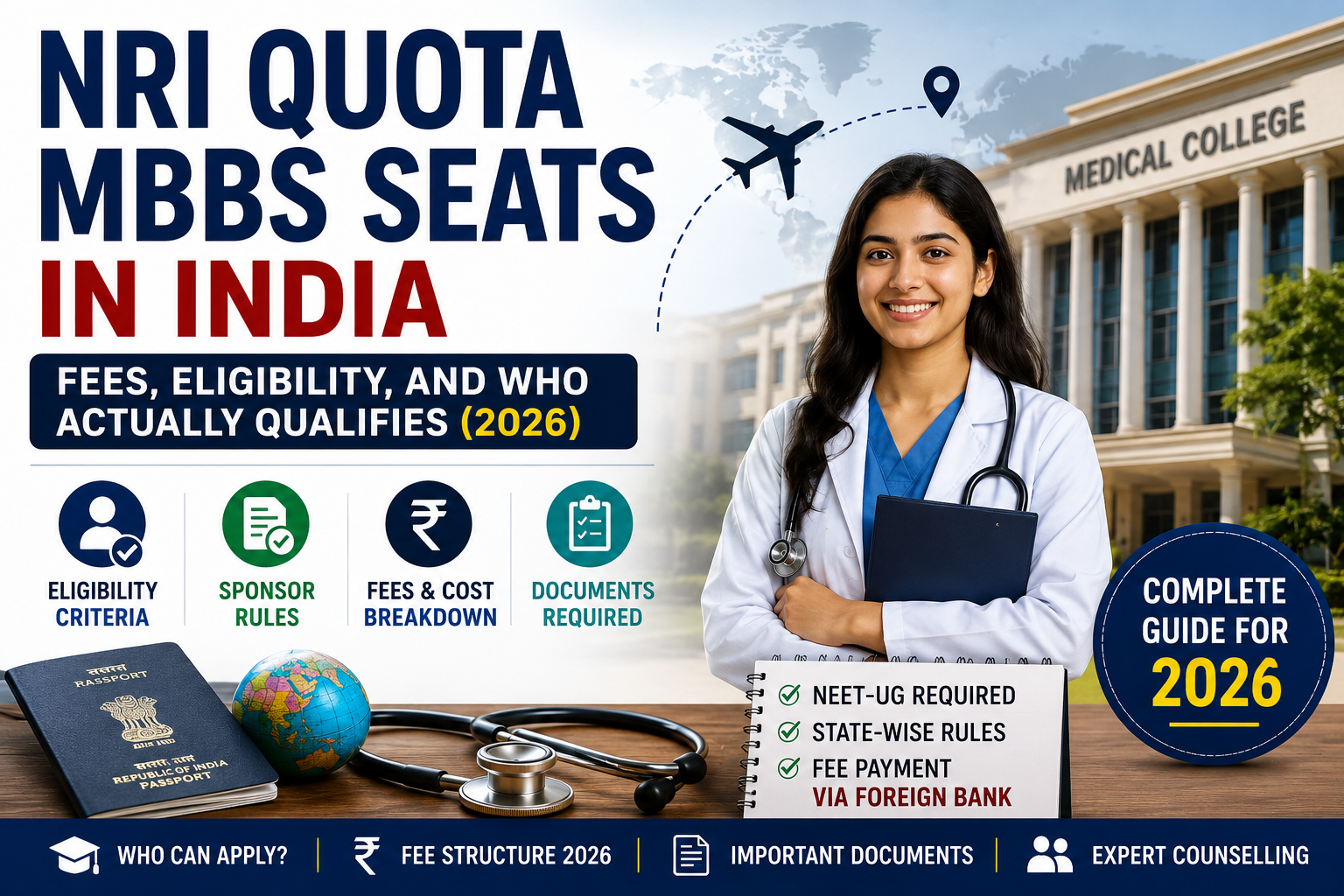
Confused about NRI quota MBBS admission in India? Learn about NRI eligibility, sponsor requirements, 2026 fees, documents, NEET rules, and state-wise differences before counselling.
NRI Quota MBBS Seats in India: Fees, Eligibility, and Who Actually Qualifies (2026)
Every counselling season, we hear some version of the same question: "My uncle lives in Dubai — can my daughter get an MBBS seat through NRI quota?" It's a fair question, and the honest answer is: maybe, but almost certainly not the way most families assume. The NRI quota is one of the most misunderstood parts of India's medical admission system — families either think it's a shortcut around NEET entirely, or they don't realise it exists at all and end up paying full management-quota fees for nothing.
This guide clears up exactly what NRI quota is, who genuinely qualifies as a candidate or sponsor, what it actually costs in 2026, and the documentation traps that derail otherwise-eligible applications every single year.
What Is NRI Quota, Really?
NRI quota is a government-regulated reservation — typically around 15% of total MBBS seats in private and deemed medical colleges — set aside for Non-Resident Indians, Overseas Citizens of India (OCI), Persons of Indian Origin (PIO), and Indian students sponsored by a qualifying NRI relative. A small number of government medical colleges in a few states, such as Rajasthan, also offer NRI seats at subsidised fee structures, though this is the exception rather than the rule.
It's easiest to think of it as a separate, less crowded lane within private and deemed admissions — not a bypass around merit altogether. You still need to qualify NEET-UG, and you're still competing against other NRI-category applicants, just a much smaller pool than the general merit list.
Who Actually Qualifies: Candidate Eligibility
A student or their sponsor can fall under the NRI category if they meet one of the following:
● The candidate is a Non-Resident Indian — an Indian citizen residing abroad for employment, business, or other purposes.
● The candidate holds an Overseas Citizen of India (OCI) or Person of Indian Origin (PIO) card.
● The candidate is an Indian resident student sponsored by a qualifying NRI relative — typically a parent, sibling, or, in some states, a specified close blood relative.
One detail that trips up a lot of families: OCI cardholders may, subject to the latest MCC guidelines, also be eligible to apply under general/UR category seats in addition to NRI quota — so it's worth checking both routes rather than defaulting straight to NRI quota.
The Sponsor Rules — Where Most Applications Go Wrong
This is the single biggest source of rejected NRI quota applications. Sponsorship rules are not uniform across India — some states insist on a close blood relationship (parent, sibling, or grandparent) between the sponsor and the candidate, while others allow broader sponsorship arrangements under specific conditions. A distant relative or family friend sponsoring a candidate may be accepted in one state and rejected outright in another.
On top of relationship rules, most colleges also require:
● An Embassy-attested Sponsorship Affidavit confirming the sponsor's relationship and financial commitment.
● Proof of the sponsor's NRI status — valid passport, visa/work permit, and residence proof abroad.
● A designated Local Guardian in India, since the sponsor resides abroad and the college needs someone reachable for emergencies and administrative matters.
A single mismatch in the Embassy certificate or sponsorship affidavit — a misspelled name, an expired document, an unclear relationship — can lead to rejection at the document verification stage, even after a seat has been provisionally allotted. This is exactly the kind of detail worth getting checked by a counsellor before counselling begins, not after.
Is NEET-UG Required for NRI Quota? Yes — No Exceptions
This is worth stating plainly because it's the most common misconception families have: NRI quota is not direct admission. Every candidate — NRI, OCI, PIO, or sponsored ward — must qualify NEET-UG and meet the minimum qualifying percentile for their category. NEET-UG 2026 is administered by the National Testing Agency, with international exam centres now available in several Gulf and Southeast Asian cities, making it easier for NRI families to have their child sit the exam without travelling to India.
What the NRI quota changes is the size of the competing pool and, because fees are considerably higher, the effective cutoff — not whether NEET is required at all.
NRI Quota MBBS Fees in 2026
Because NRI quota fees are typically paid in foreign currency and colleges price these seats for a smaller, less rank-sensitive pool, they run significantly higher than general or even management quota fees — often 2.5 to 3 times the management quota rate at the same college.
Seat Category | Fee Range (per year) | Notes |
NRI quota — private colleges | ₹12 lakh – ₹30 lakh | Varies widely by college reputation and state |
NRI quota — deemed universities | ₹20 lakh – ₹45 lakh | Premium deemed universities sit at the top end |
NRI quota — government colleges (select states) | ₹3 lakh – ₹8 lakh | Rare; Rajasthan is a notable example |
Total course cost (5.5 years, private/deemed) | ₹70 lakh – ₹2.2 crore | Excludes hostel, living, and one-time charges |
One rule families are frequently caught off guard by: fee payments under NRI quota must generally be made via wire transfer directly from the sponsor's foreign bank account. Cash payments or transfers from an Indian savings account are not compliant with FEMA (Foreign Exchange Management Act) regulations and can jeopardise the admission. This is a compliance detail worth confirming with the college's finance office in writing before making any payment.
NRI Quota vs Management Quota vs General Merit
Factor | General Merit | Management Quota | NRI Quota |
Basis of admission | NEET rank, open competition | NEET qualifying score + payment | NEET qualifying score + NRI/sponsor eligibility |
Typical annual fee | ₹8 lakh – ₹15 lakh (private) | ₹15 lakh – ₹30 lakh | ₹12 lakh – ₹45 lakh |
Competition pool | Very large | Moderate, budget-dependent | Small, category-specific |
Extra eligibility needed | None beyond NEET | None beyond NEET + payment capacity | NRI/OCI/PIO status or valid sponsor |
Payment method | Indian bank transfer | Indian bank transfer | Foreign wire transfer (FEMA-compliant) |
State-Wise Variation: Why You Must Check Local Rules
NRI quota eligibility, sponsorship rules, and even seat availability are decided at the state counselling authority level, layered on top of MCC and NMC guidelines — which means the rules genuinely differ from state to state. Some states mandate a close blood relationship for sponsorship; others are comparatively flexible. A handful of states, like Rajasthan, extend a limited number of NRI seats to government medical colleges at far more reasonable fees than the private-college norm. Always verify the current-year notification from the specific state counselling authority you're applying through rather than relying on a neighbouring state's rules.
Documents You'll Need
● NEET-UG 2026 scorecard and admit card
● Valid passport of the candidate and the sponsor
● Proof of NRI status — visa, work permit, or residence card of the sponsor
● Embassy-attested sponsorship affidavit establishing the relationship
● OCI/PIO card, where applicable
● Local guardian details and consent, where required by the college
● Proof of funds / bank statements supporting the fee commitment
Frequently Asked Questions
1. Can I get an MBBS seat through NRI quota without NEET-UG?
No. NEET-UG qualification is mandatory for every category, including NRI quota — there is no direct-admission route. The quota changes your competing pool and effective cutoff, not the NEET requirement itself.
2. Who can sponsor a candidate under NRI quota if the student themselves isn't an NRI?
Typically a parent, sibling, or in some states a close blood relative who holds valid NRI, OCI, or PIO status. Exact sponsor-relationship rules vary by state, so this should be verified against the specific state's current counselling guidelines before applying.
3. Are OCI and PIO cardholders automatically eligible for NRI quota?
Yes, OCI and PIO cardholders are generally eligible for NRI quota seats. OCI cardholders may, depending on the latest MCC guidelines, also be considered for general/UR category seats — worth checking both options.
4. Why are NRI quota fees so much higher than management quota?
NRI quota fees are typically 2.5 to 3 times management quota fees at the same college, largely because they're priced for a smaller pool of candidates who aren't competing primarily on NEET rank, and are usually payable in foreign currency.
5. Can NRI quota fees be paid in cash or from an Indian bank account?
No. Under FEMA regulations, NRI quota fee payments generally must be made via wire transfer directly from the sponsor's foreign bank account. Cash payments or Indian-account transfers can put the admission at risk and should be avoided.
6. Is a government college NRI seat available anywhere in India?
It's rare, but yes — a few states, such as Rajasthan, offer a limited number of NRI quota seats in government medical colleges at significantly lower fees than private or deemed colleges. Availability is limited and state-specific.
Get Your Sponsorship and Documentation Verified Before Counselling Begins
NRI quota can be a genuinely good option for families who have a qualifying sponsor but a NEET score that falls short of general merit cutoffs — but the documentation and sponsorship rules are unforgiving, and a single error can cost a family a seat they were otherwise eligible for. At All About Doctor, our doctor-led counselling team checks your sponsor eligibility, state-specific rules, and full documentation before counselling opens, alongside a transparent fee breakdown for every college you're considering. Start with a free NEET-UG counselling session to see where your NEET score and NRI eligibility actually place you this year.
For a full comparison of what MBBS actually costs across categories, see our guide on Government vs Private MBBS Seats in India, and if NRI quota fees feel out of reach, it's worth comparing them against MBBS abroad options, which are often significantly cheaper for the same medical degree.
Before finalising any college or sponsor arrangement, verify current rules directly on the Medical Counselling Committee (MCC) portal and confirm a college's recognition status on the official National Medical Commission website.
Not sure if your NRI relative qualifies as a sponsor? Talk to an All About Doctor counsellor — the first session is free.

Student Counsellor
Working with students has always been about understanding their dreams and helping them find the right direction in life.Read more
Ready to Take Your Next Steps?
Get in touch with our team to discuss how we can help you achieve your goals
Call Us
+91 9773370141
Available Mon-Sat, 9AM-9PM
Email Us
Info@allaboutdoctor.in
We'll respond within 24 hours
Visit Us
2nd Floor, Santosh vihar, C-62, VIT Rd, Vishwa Vidhyalaya Nagar, Jagatpura, Jaipur, Rajasthan 302017
Send Us a Message
We respect your privacy. Your information will be kept confidential.
Comments (0)
Join the discussion and share your thoughts
Leave a Comment
Comments (0)
No comments yet. Be the first to comment!