









Government vs Private MBBS Seats in India: Real Fee Difference and How to Decide
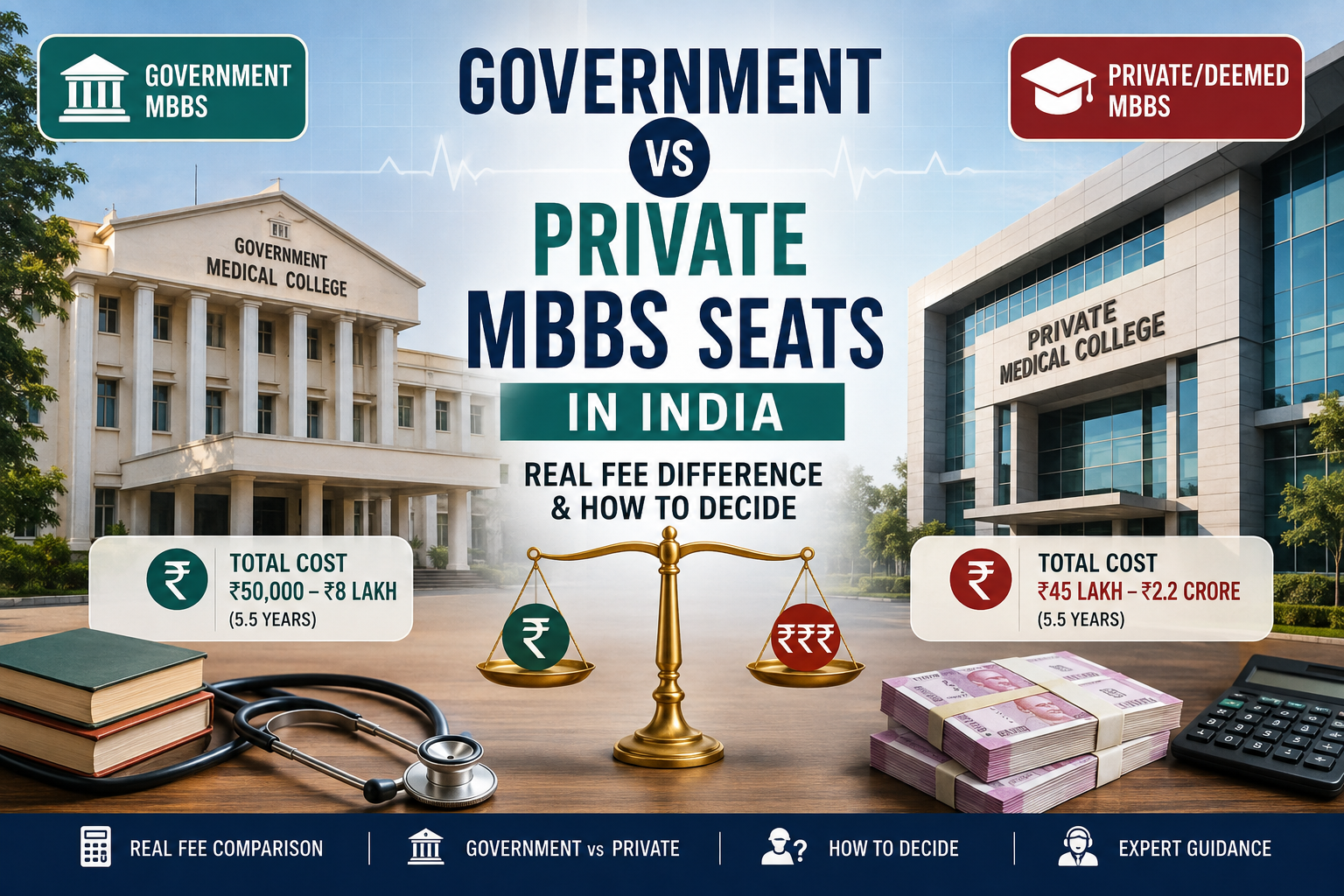
Confused between government and private MBBS colleges in India? Compare 2026 fees, admission requirements, seat availability, hidden costs, and understand which option makes sense for your NEET rank and budget.
Government vs Private MBBS Seats in India: Real Fee Difference and How to Decide
If you ask ten different families how much an MBBS degree costs in India, you'll get ten wildly different answers — and all of them can be true at once. That's because India doesn't really have one MBBS fee structure. It has two almost entirely separate systems running in parallel: government medical colleges, where fees are so low they barely register, and private or deemed universities, where the same degree can cost more than a house. Understanding this gap — and where your NEET score actually places you — is the single most important financial decision a medical aspirant's family will make.
This piece breaks down the real 2026 numbers for both government and private MBBS seats in India, explains why the gap is so wide, and gives you a practical way to decide which path fits your rank, budget, and long-term goals.
Government MBBS Fees in India: The Real Numbers
Government medical colleges remain the cheapest route to an MBBS degree anywhere in the world. At institutions like AIIMS Delhi, total fees for the entire course can stay under ₹2,000 — a number that genuinely surprises most people the first time they hear it. Most other state government colleges charge somewhere in the ₹10,000 to ₹1.5 lakh per year range, depending on the state, category, and whether you're on an All India Quota (AIQ) or state quota seat.
There's real variation state to state, though. Some state-run colleges under management or NRI-linked quotas charge noticeably more than the pure government rate — in a few states, even government college fees for certain quota seats can run into several lakhs per year, so it's worth checking your specific state's fee notification rather than assuming a flat number applies everywhere.
Government MBBS Fee Snapshot (2026)
Fee Component | Typical Range (per year) | Notes |
Tuition fee | ₹500 – ₹1.5 lakh | Varies by state and college type |
Hostel fee | ₹5,000 – ₹25,000 | Government hostels are heavily subsidised |
Mess/food | ₹20,000 – ₹40,000 | Optional if living off-campus |
Other charges (library, exam, etc.) | ₹2,000 – ₹10,000 | One-time or annual, college-specific |
Total course cost (5.5 years) | ₹50,000 – ₹8 lakh | Excludes personal expenses |
The catch, as most aspirants already know, is that this affordability comes with brutal competition. Government seats are allotted almost entirely on NEET-UG merit, and with over 11 lakh candidates competing for around 63,000 government MBBS seats this year, a difference of even a few marks can decide whether a family pays ₹50,000 or ₹50 lakh for the same degree.
Private and Deemed MBBS Fees in India: The Real Numbers
Private and deemed medical universities operate on a completely different financial model. Because they don't receive government subsidies, tuition alone typically runs ₹8 lakh to ₹25 lakh per year. At the more premium deemed universities, the full 5.5-year course — including hostel and other mandatory charges — can cross ₹1 crore.
Within private colleges, there's also a quota structure that changes the price further. Management quota and NRI quota seats, which don't depend on your NEET rank beyond the minimum qualifying score, are priced significantly higher — often ₹15 lakh to ₹45 lakh per year — precisely because they trade rank-based merit for guaranteed admission.
Private/Deemed MBBS Fee Snapshot (2026)
Seat Type | Tuition (per year) | Total Course Cost (approx.) |
Private college — merit quota | ₹8 lakh – ₹15 lakh | ₹45 lakh – ₹85 lakh |
Private college — management quota | ₹15 lakh – ₹30 lakh | ₹85 lakh – ₹1.5 crore |
Deemed university — merit quota | ₹18 lakh – ₹25 lakh | ₹1 crore – ₹1.3 crore |
NRI quota (private/deemed) | ₹25 lakh – ₹45 lakh | ₹1.4 crore – ₹2.2 crore |
It's worth noting that these figures are before hostel, mess, uniforms, equipment, and the informal costs that come up over 5.5 years — so families budgeting for a private seat should plan for the sticker price plus a reasonable buffer, not the sticker price alone.
Why the Gap Is So Wide
The difference isn't really about the quality of the degree — both government and private MBBS degrees are recognised by the National Medical Commission (NMC) and carry the same licence to practise. The gap comes down to funding models: government colleges are subsidised by the state, so the college absorbs most of the actual cost of training a doctor, while private and deemed universities pass that entire cost — plus a margin — directly onto the student.
This is also why government seats are rationed so tightly through NEET rank, while private seats are far more accessible to anyone who can pay, subject only to a qualifying NEET score.
Government vs Private MBBS: Side-by-Side Comparison
Factor | Government MBBS | Private/Deemed MBBS |
Total course cost | ₹50,000 – ₹8 lakh | ₹45 lakh – ₹2.2 crore |
Admission basis | NEET-UG rank (merit) | NEET qualifying score + quota/payment |
Seat availability | ~63,000 seats nationally | ~73,000 seats nationally |
Infrastructure & hospital exposure | Often older but high patient volume | Usually newer, sometimes lower patient load |
NMC recognition | Yes | Yes (verify specific college) |
Post-MBBS licensing exam | Not required | Not required (India-based degree) |
Competition level | Extremely high | Comparatively lower, budget-dependent |
How to Actually Decide
There's no single right answer here — the honest decision depends on three factors working together, not just one.
● Your NEET-UG rank: if you're realistically within range of a government seat (check the previous year's closing ranks for your category and state), it's almost always worth waiting for counselling rounds before considering a private seat.
● Your family's budget ceiling: private and deemed seats can mean committing ₹45 lakh to over ₹1 crore — a number that should be weighed against education loans, existing savings, and what else that money could secure (including MBBS abroad, which is often 40–70% cheaper than a private Indian seat for the same outcome).
● Your timeline and risk appetite: government counselling runs in multiple rounds and can stretch over months, including a stray vacancy round for last-chance seats — private admissions tend to move faster but lock in a much larger financial commitment early.
A practical rule many counsellors use: if your rank gets you into any government college — even one that isn't your first choice of city or specialty — it is very rarely worth paying private/deemed fees instead, purely on cost-per-value grounds. Private seats make the most sense when a government seat genuinely isn't within reach and MBBS abroad has already been ruled out for personal reasons.
A Note on the Hidden Costs of Private MBBS
Private MBBS admissions sometimes come with costs that don't appear on the official fee structure — building or infrastructure development funds, caution deposits (partly refundable), and annual increases that aren't always disclosed upfront. Always ask for the college's complete, year-wise fee schedule in writing before paying any admission amount, and cross-check it against the fee approved by the state fee-regulating committee, since private colleges in most states are required to have their fees approved rather than set arbitrarily.
Frequently Asked Questions
1. Is a private MBBS degree in India valid for practice, just like a government one?
Yes. As long as the college is recognised by the National Medical Commission, a private or deemed MBBS degree carries the same licence to practise as a government college degree. The recognition of the college matters far more than whether it's government or private.
2. Can I get a government MBBS seat through management quota?
No. Government colleges allot seats purely through NEET-UG merit under AIQ or state quota rules. Management quota and NRI quota seats exist only within private and deemed universities.
3. Are private MBBS fees the same across all states?
No. Private MBBS fees vary significantly by state, largely because each state's fee-regulating committee sets its own approved fee ranges for private colleges. It's worth checking your specific state's latest fee notification rather than assuming a national average applies.
4. Is MBBS abroad cheaper than a private MBBS seat in India?
In most cases, yes. Total costs for MBBS abroad in NMC-approved destinations typically range from ₹18 lakh to ₹55 lakh for the full course, compared to ₹45 lakh to over ₹1 crore for a private or deemed seat in India — though families should always verify a foreign university's NMC compliance before enrolling.
5. What happens if I don't get either a government or an affordable private seat?
Many students in this situation explore NMC-approved MBBS abroad options, or alternative courses like BDS, BAMS, or BHMS in India. A doctor-led counselling session can help map out which of these actually fits your NEET score and budget.
Get a Realistic Fee Comparison for Your Own NEET Score
Generic fee ranges are a starting point, but the number that actually matters is what your specific NEET-UG rank and category qualify you for — government, private, or otherwise. At All About Doctor, our doctor-led counselling maps your real options across government colleges, private colleges, and NMC-approved universities abroad, with a transparent, itemised cost sheet for each. If you're weighing this decision, start with our free NEET-UG counselling session to see exactly where your rank places you this year.
For a deeper look at how Indian MBBS costs compare to studying abroad, see our guide on MBBS in India vs MBBS Abroad 2026, or explore the full real cost breakdown of MBBS abroad — including tuition, living costs, and hidden expenses.
Before finalising any college, you can also verify a college's recognition status directly on the official National Medical Commission website, and check the latest seat matrix on the Medical Counselling Committee (MCC) portal.
Want a personalised breakdown of your government vs private options based on your actual NEET score? Talk to an All About Doctor counsellor — the first session is free.

Medical Mentor & Founder
As a doctor, I believe medicine is not just a profession — it is a lifelong commitment to serve humanity.Read more
Ready to Take Your Next Steps?
Get in touch with our team to discuss how we can help you achieve your goals
Call Us
+91 9773370141
Available Mon-Sat, 9AM-9PM
Email Us
Info@allaboutdoctor.in
We'll respond within 24 hours
Visit Us
2nd Floor, Santosh vihar, C-62, VIT Rd, Vishwa Vidhyalaya Nagar, Jagatpura, Jaipur, Rajasthan 302017
Send Us a Message
We respect your privacy. Your information will be kept confidential.
Comments (0)
Join the discussion and share your thoughts
Leave a Comment
Comments (0)
No comments yet. Be the first to comment!